Best Casinos for Online Craps in Australia
 Available in AU
Legal Landscape for Online Craps in Australia (2026)
I spent a stupid amount of time trying to figure out whether I could legally play craps online from my couch in Australia. Not because I’m cautious by nature — I’ve made worse decisions with worse odds — but because the answer turned out to be more tangled than I expected. Every forum had a different opinion, half the "casino guide" sites just said "check your local laws" and moved on, and nobody actually walked through what the law says versus what it means for you personally. So here’s what I found, laid out properly.
There’s no single craps law, because there’s no single gambling law
The first thing that trips people up: Australia doesn’t have one gambling act that covers everything. There’s no single overarching statute or single overarching gambling authority regulating gambling in the country. Instead, you’ve got regulation happening at two levels at once — federal and state/territory — and they don’t always agree on who’s in charge of what.
Since online craps relies on smooth deposits, fast payouts and bonuses that actually stretch your bankroll, it helps to see how each casino stacks up before you sit down at the table.
Bonus: up to A$750 + 50 jackpot spins, 35x wagering · Payout speed: crypto ~90 minutes, fiat 1-5 days · Min. deposit: A$30 Kingmaker offers a welcome package worth up to A$750 plus 50 jackpot spins with 35x wagering, and you can expect crypto payouts in around 90 minutes or fiat within a few days, with a A$30 minimum deposit.
License: Curacao eGaming OGL/2023/174/0082 (Dama N.V.) · Bonus: up to A$10,000 + 500 free spins across 4 deposits · Min. deposit: A$15 LevelUp Casino runs under a Curacao eGaming license from Dama N.V. and spreads a bonus of up to A$10,000 plus 500 free spins across four deposits, with a low A$15 minimum deposit to get started.
License: Curacao · Bonus: 100% up to A$500 + 200 free spins, 10x wagering · Payout speed: crypto 30-60 minutes, fiat 1-5 days · Min. deposit: A$10 Wild Tokyo is Curacao licensed and pairs a 100% match up to A$500 with 200 free spins at 10x wagering, backed by fast crypto payouts in as little as 30 minutes and a low A$10 minimum deposit.
Bonus: 240% up to A$4,100 + 300 free spins WinShark stands out for a hefty 240% bonus up to A$4,100 plus 300 free spins, giving you a substantial boost to explore the tables.
Bonus: up to A$7,500 + 550 free spins across 10 deposits, 50x wagering · Payout speed: crypto under 1 hour, PayID 1-3 business days · Min. deposit: A$20 (A$30 to qualify for the bonus) Ricky Casino spreads a bonus of up to A$7,500 plus 550 free spins across ten deposits at 50x wagering, with crypto payouts under an hour and PayID processed within a few business days for a A$20-30 deposit.
License: Curacao Gaming Control Board OGL/2023/176/0095 (Hollycorn N.V.) · Bonus: up to A$11,000 + 300 free spins (code NEO100) Neospin holds a Curacao Gaming Control Board license via Hollycorn N.V. and offers up to A$11,000 plus 300 free spins using the code NEO100.
License: Tobique Gaming Commission · Bonus: up to A$8,000 + 400 free spins across 4 deposits · Payout speed: crypto ~10-15 minutes, fiat 1-5 days · Min. deposit: A$30 SkyCrown is licensed by the Tobique Gaming Commission and offers up to A$8,000 plus 400 free spins across four deposits, with crypto withdrawals landing in around 10-15 minutes and a A$30 minimum deposit.
License: Curacao eGaming (Dama N.V.) · Bonus: up to A$10,000 + 180 free spins, 40x wagering JeetCity Casino operates under a Curacao eGaming license from Dama N.V. and offers up to A$10,000 plus 180 free spins with 40x wagering.
License: Curacao Gaming Authority (Jumpman Gaming Ltd) · Bonus: up to A$6,600 + up to 250 free spins across 4 deposits DragonSlots Casino is licensed by the Curacao Gaming Authority under Jumpman Gaming Ltd and spreads a bonus of up to A$6,600 plus up to 250 free spins across four deposits.
License: Curacao eGaming (Roby Games Ltd) · Bonus: 100% up to A$750 + 200 free spins Roby Casino runs under a Curacao eGaming license held by Roby Games Ltd and offers a 100% match up to A$750 plus 200 free spins.
At the federal level, the relevant law is the Interactive Gambling Act 2001 (IGA), and it’s the primary Commonwealth law governing online gambling in Australia. It was introduced with a focus on harm minimisation — protecting the public, not filling government coffers. Worth noting here: some sources cite an "Interactive Gambling Act 1997" as the law prohibiting online casino games for Australian residents, while others point to the 2001 Act as the one doing that job. I’m not going to pretend this discrepancy doesn’t exist or quietly pick one — the sources disagree on the year, and I’d rather flag that than hand you a fake certainty. What both versions agree on is the substance: online casino games are prohibited for Australian residents under this legislation, whichever year you attach to it.
And craps, as an online casino table game, falls into the same bucket as slots, poker, blackjack, and roulette — all of these are prohibited under the Interactive Gambling Act 2001 when offered as real-money online casino products to people in Australia.
Who the law actually targets — and it’s not you
Here’s the part that surprised me most, and the part I wish someone had told me plainly before I spent an evening panicking about whether I’d committed some crime by loading up a craps table on an offshore site years ago.
Playing on offshore online casinos can expose you to financial loss and difficulty retrieving withdrawals, as these operators are breaking Australian law.
The law targets operators, not players. It is not illegal for individual Australians to play at offshore-licensed online casinos. The Interactive Gambling Act makes it illegal to offer online casino gambling to Australians — meaning it’s the site running the game that’s breaking the law, not the person clicking "roll." It is illegal to offer online casino gambling in Australia, and it’s not possible to obtain a licence to operate an online casino domestically at all. There’s simply no legal pathway for a local operator to open an online casino, craps included.
Practically, this means:
- There are no domestically licensed real-money online casino operators available to Australian players. None. Not one.
- Any craps table you find online is, by definition, running on an offshore licence — because a domestic one for this purpose doesn’t exist.
- You, as a player, aren’t the one the law is aimed at. The site is.
That last point matters because a lot of "responsible gambling" copy on other sites tells you to "only play at licensed operators" as if there’s a local licence to check for. There isn’t. Saying "check the operator’s Australian licence" for an online casino game is meaningless advice on this market — the licence being referenced doesn’t exist, because none can be issued. If a site is offering you online craps, its licence — whatever it is — comes from somewhere else entirely, not from any Australian regulator.
Who actually polices this, and how
Since there’s no single regulator, responsibility splits up in a way that took me a while to map out properly.
Federally, the Australian Communications and Media Authority (ACMA) is the body that enforces the Interactive Gambling Act 2001. ACMA doesn’t license casinos — remember, it can’t, because none can be licensed domestically for this purpose — its job is enforcement against illegal offshore operators reaching Australian residents. Since November 2019, ACMA has ordered internet service providers to block illegal offshore gambling sites. That’s the main lever it pulls: not fines against players, not raids, but blocking orders sent to ISPs so that the sites become harder to reach from an Australian internet connection.
Since November 2019, ACMA has required ISPs to block access to illegal offshore gambling sites.
At the state and territory level, things get more fragmented. Each Australian state and territory has its own separate gambling regulator, and their jurisdiction is generally domestic — land-based venues, state lotteries, wagering companies registered in that state. For example:
- The Victorian Gambling and Casino Control Commission (VGCCC) monitors wagering service providers — including ones based in other states — for compliance with the National Consumer Protection Framework. So its reach extends a bit beyond Victoria’s borders when it comes to interstate wagering operators, but that’s still a domestic framework.
- Land-based casinos, wherever they are in the country, are regulated by state government regulators and law enforcement agencies — a completely separate track from ACMA’s federal oversight of online gambling. A physical casino floor and an online craps table answer to different watchdogs entirely.
- The Northern Territory Racing Commission (NTRC) occupies an odd position: it’s often described as Australia’s de-facto online gambling regulator, because it’s the body that licenses most national online bookmakers, who set up there partly because of lower tax rates. But that’s about sports and race betting operators, not online casino games — craps doesn’t fall under what the NTRC licenses.
Here’s the catch that matters most for anyone thinking about craps specifically: state and territory regulators like VGCCC or Liquor & Gaming NSW have limited power over offshore online casinos. They can regulate what’s licensed inside their own state. They can’t reach into a site licensed in another jurisdiction entirely and shut down its craps tables. That job, to the extent it happens at all, falls back to ACMA and its blocking orders — and even that is a game of whack-a-mole, since blocked domains tend to reappear under new ones.
What this actually means if you want to play craps online
Strip away the legal architecture and here’s the practical shape of it:
- Playing craps online as an Australian resident isn’t a crime for you. The law doesn’t criminalise the act of playing. It criminalises offering the game to you in the first place.
- No Australian operator can legally offer it to you. So any online craps table you come across is running under a licence issued somewhere else — because that’s the only kind of licence that can exist for this activity.
- Nobody enforces a domestic licensing standard here, because there isn’t one to enforce. ACMA’s enforcement is about blocking access to offshore sites, not certifying which ones are “approved” for Australians — there’s no approval process on this side of it.
- State regulators mostly can’t touch this. Their authority is domestic. An offshore craps table is outside their reach almost by definition.
I think this is where a lot of the confusion online comes from. People read "regulated" in a casino review and assume it means "cleared for Australians." It doesn’t, and it can’t, because that clearance doesn’t exist as a category. What "regulated" actually refers to, in every legitimate case, is a licence from somewhere else — Malta, the UK, or elsewhere — governing that operator’s conduct in that jurisdiction, not in ours.
The bit nobody likes putting in writing
I’ll say plainly what a lot of casino content dances around: there is no register you can check, no Australian licence number to verify, no local authority you can call to confirm a craps table is "approved" for you to play. That’s not a gap in reporting — it’s the actual state of the law. If a site tells you to "check their Australian licence," they’re either confused or hoping you won’t ask the follow-up question.
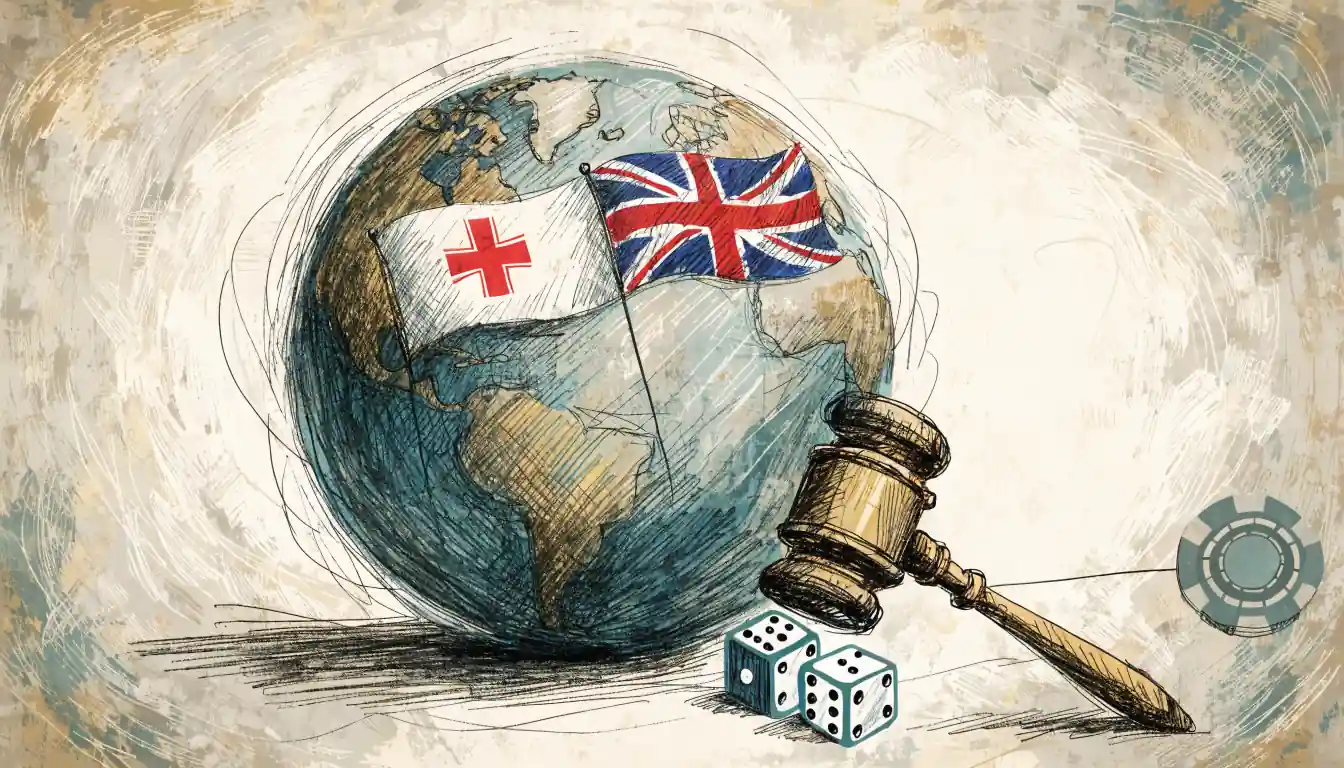
What you can check is where the operator’s actual licence is from and what regulator stands behind that jurisdiction — that’s a real, verifiable thing, just not an Australian one. Bodies like the Malta Gaming Authority or the UK Gambling Commission are the kind of names that would appear on a legitimate operator’s licensing information, because those are places that actually issue this kind of licence. That’s a different question from "is this legal for me specifically," and worth keeping separate in your head.
Enforcement is real, but it’s aimed upstream
None of this means the space is a free-for-all with zero consequences for anyone. ACMA’s ISP-blocking campaign, running since November 2019, is a standing enforcement mechanism, not a one-off announcement. It’s aimed at making offshore operators harder to reach and, by extension, less commercially viable in the Australian market — squeezing them from the demand side without criminalising the people generating that demand.
That’s the tension at the heart of the whole legal picture: harm minimisation as the stated goal of the Interactive Gambling Act, enforcement pointed at supply rather than at individual players, and a regulatory map split across a federal body with no licensing power over online casinos and a patchwork of state regulators whose authority mostly stops at their own borders. It’s not tidy. But it’s consistent enough that you can actually plan around it, once you know where the lines are.
Where the actual protections come from
Since there’s no Australian licence to lean on for reassurance, and no domestic complaints body to contact about an online craps table specifically, whatever consumer protection exists on a given site comes from the jurisdiction where that operator is actually licensed — not from anything Australian. That’s worth remembering before you take "secure and licensed" at face value in any marketing copy. Secure and licensed where, and does that jurisdiction’s regulator actually have any power to do anything if something goes wrong? Those are the two questions the law leaves entirely up to you to ask, because no local body is positioned to ask them on your behalf.
If gambling starts costing you more than money — time, sleep, relationships, the usual list — that’s a separate problem from the legal one, and it’s one Australia does have local infrastructure for, through services like Gambling Help Online, regardless of where the operator you’re playing with happens to be licensed.
Checking Operator Licences
Always verify the jurisdiction and regulator that issued the operator’s licence (e.g., Malta Gaming Authority, UK Gambling Commission). This information tells you where the legal protection actually resides, since no Australian licence exists.
None of this is a warning to scare you off craps specifically. It’s the same legal shape that applies to every online casino game in this country — the table game just happens to sit inside a bigger legal question that most casino pages skip past on the way to talking about house edges and betting strategies. Better to know the shape of the fence before you decide how close to walk to it.
Craps Game Mechanics and What to Expect in Australian Casinos
I’ll be honest: the first time I stood at a craps table, I had no idea what was happening. Dice flying, people shouting, a dealer moving chips across a felt layout that looked like it needed its own instruction manual. It took me a few sessions — and a fair bit of money I’d rather not think about — to actually understand what was going on. So let’s skip the confusion and get into the mechanics.

The Basic Idea
Craps is built around one player, the "shooter," rolling two dice while everyone else bets on the outcome. You don’t need to be the shooter to play — most people at the table are just betting on someone else’s roll. The game happens in rounds built around a "come-out roll," which is the first roll of a new round.
If that come-out roll lands on 7 or 11, that’s an instant win for anyone who bet on the "Pass Line." Roll a 2, 3, or 12, and Pass Line bets lose immediately — that’s called "craps," which is actually where the game gets its name. Any other number (4, 5, 6, 8, 9, or 10) becomes the "point." Once a point is set, the shooter keeps rolling until either that same number comes up again (Pass Line bets win) or a 7 shows up (Pass Line bets lose, and the round ends).
That’s the skeleton of the game. Everything else — and there’s a lot else — is just different ways to bet on what happens inside that skeleton.
Basic Craps Round
The shooter throws the dice; a 7 or 11 wins for Pass Line bets, loses on 2, 3 or 12.
If the roll is 4, 5, 6, 8, 9 or 10, that number becomes the point.
The shooter continues rolling until the point number appears again (win) or a 7 appears (loss).
The Table Layout
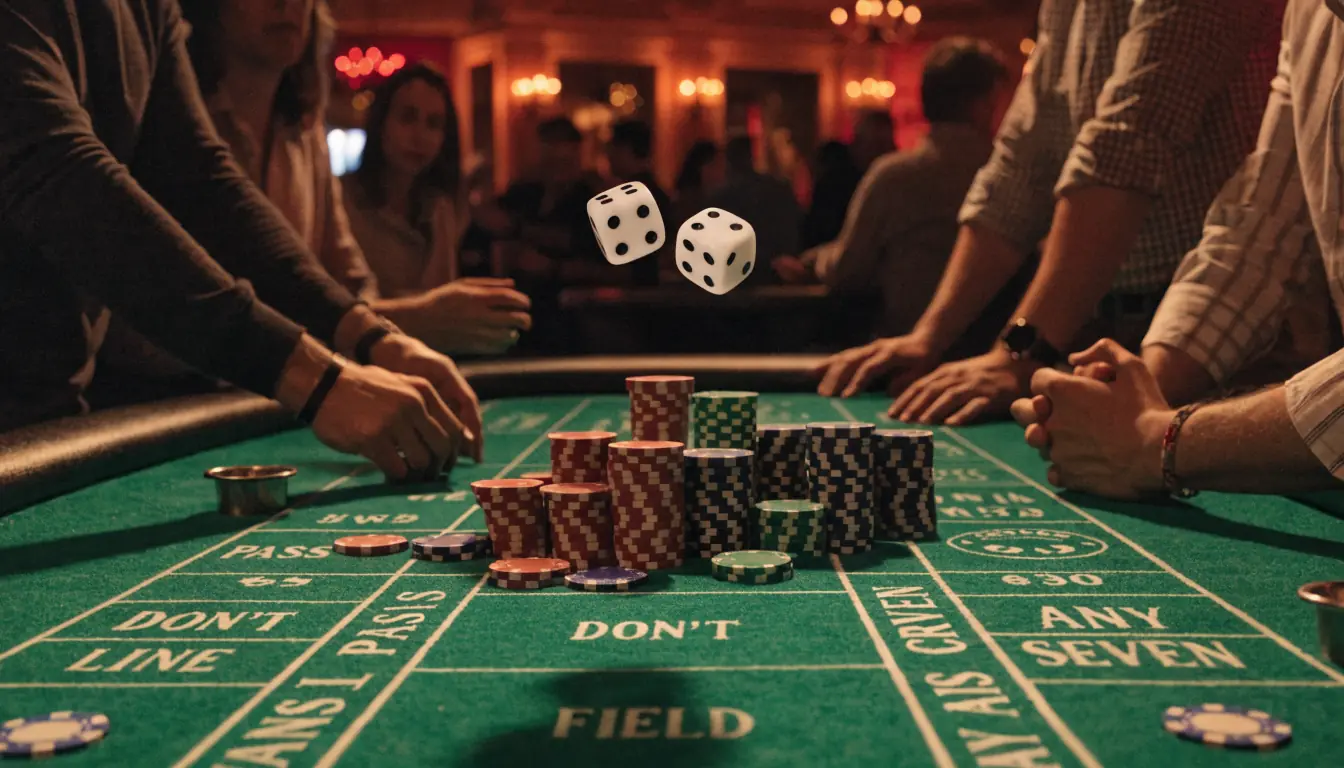
Craps tables look intimidating because the layout is genuinely dense. You’ve got the Pass Line running along the front edge closest to the players, the Don’t Pass Bar just behind it, and then a whole field of proposition bets, hardways, and the "Come" and "Don’t Come" areas in the middle. Above all that sits the number grid — 4, 5, 6, 8, 9, 10 — where "Place" bets go once a point is established.
In a physical Australian casino, the table is staffed by a "boxman" who oversees the game, one or two dealers who handle the chips on either side, and a "stickman" in the middle who calls the rolls and controls the dice with a long wooden stick. If you’ve never played, just watch a round or two before jumping in — nobody expects you to know the layout by heart on your first visit, and the dealers are generally used to explaining where to put your chips.
Online, the layout gets simplified. You’re clicking on betting zones on a screen rather than physically placing chips, and there’s no stickman sliding dice across a table. A live dealer version tries to recreate the physical experience with a real dealer and real dice on camera, but the betting interface itself is still a digital overlay.


Types of Bets
This is where craps either grabs you or scares you off. There are more bet types on a craps table than on almost any other casino game, and they carry wildly different odds.
Pass Line and Don’t Pass are the simplest and most common. You’re essentially betting with or against the shooter. Pass Line bets win on a come-out roll of 7 or 11 and lose on 2, 3, or 12. Don’t Pass is close to the mirror image, though the number 12 is usually treated as a push rather than a loss — the house needs some edge, and that’s where it lives on this particular bet.
Come and Don’t Come bets work the same way as Pass and Don’t Pass, except you can place them after the point has already been established, essentially starting your own mini-round within the round.
Place bets let you bet on a specific number (4, 5, 6, 8, 9, or 10) coming up before a 7. These pay out at different rates depending on which number you pick, because some numbers are statistically easier to roll than others.
Field bets are one-roll bets on the very next roll landing on a specific set of numbers. Fast, simple, over in seconds — which is exactly why I used to throw money at them without thinking.
The simplest bet; wins on a 7 or 11 on the come‑out roll, loses on 2, 3 or 12.
Bet on a specific number (4,5,6,8,9,10) to appear before a 7; payouts vary by number.
High‑risk, single‑roll bets with the worst odds on the table, such as “any 7”.
Proposition bets are the ones in the middle of the table — things like betting on a specific hardways combination, or on the next roll being a 7. These carry the worst odds on the table by a wide margin. If you see a table covered in chips on the "any 7" square, that’s usually tourists, not regulars.
Here’s a stripped-down table of the main bet families, since keeping them straight matters more than most guides let on:
| Bet Type | When You Place It | Basic Idea |
|---|---|---|
| Pass Line | Before the come-out roll | Betting with the shooter |
| Don’t Pass | Before the come-out roll | Betting against the shooter |
| Come | After the point is set | Same as Pass Line, started later |
| Don’t Come | After the point is set | Same as Don’t Pass, started later |
| Place | After the point is set | Betting a specific number hits before 7 |
| Field | Any time | One-roll bet on a group of numbers |
| Proposition | Any time | High-risk, high-payout single-roll bets |
Odds Bets and Why Regulars Use Them
Once a point is established, most experienced players add what’s called an "odds bet" behind their original Pass or Don’t Pass bet. This is the one part of craps where the house doesn’t take a cut at all — it’s paid out at true odds. I didn’t understand this for a long time, and honestly it’s the single most useful thing anyone told me at a table: if you’re going to bet on craps at all, learning to use odds bets properly is the difference between playing the game and just donating to the casino.
RTP and What It Actually Means at the Table
Return to player, or RTP, gets thrown around a lot in casino marketing, and craps is one of the few table games where it genuinely varies bet-to-bet rather than being a single fixed number for the whole game. A Pass Line bet with odds behind it sits close to the best RTP on the floor. A proposition bet in the middle of the table can sit far below it. Nobody prints this on a card at the table, so you’re relying on knowing it going in.
Where things get murkier is on the electronic and virtual versions you’ll find in some venues and online platforms — machines that simulate the dice roll with an RNG instead of physical dice. One industry review I came across cited a specific manufacturer’s RTP figure of 94% for one of these electronic craps units, quoted directly by the equipment provider itself. That number belongs to one machine, from one supplier, and isn’t something you can assume carries over to a different cabinet, a different platform, or a live dealer table with real dice. Physical dice don’t have an RTP setting — they have actual probability, unaffected by anything programmed into a machine. Electronic and RNG-based versions do have a programmed RTP, and it’s worth checking which kind of craps you’re actually sitting down at before assuming anything about your odds.
What the Casino Floor Actually Feels Like
If you’ve only seen craps in movies, the real thing is louder and slower at the same time. Louder because a good roll gets a genuine reaction — people cheering when the shooter keeps making numbers, groaning in unison when a 7 shows up and ends the run. Slower because between rolls there’s a lot of chip-shuffling, bet adjusting, and the stickman calling out numbers and settling bets before the next roll happens.
Crown Melbourne, the largest casino in the Southern Hemisphere, gives a decent sense of scale for what a serious craps pit looks like in Australia — multiple tables running at once, dealers who’ve clearly done this thousands of times, and a rhythm to the game that takes a session or two to actually follow. Don’t expect to walk up and understand every call the stickman makes on your first visit. I didn’t, and I’d read about the game beforehand.
One thing worth knowing before you sit down anywhere: support staff on the floor, and customer service lines tied to online platforms offering craps, aren’t necessarily available around the clock. If something goes wrong with a bet or a payout outside business hours, you may be waiting until the next shift or the next business day for it to get sorted. That’s just the reality of how staffing works, not a red flag on its own, but it’s the kind of thing you want to know before you need it rather than after.
Live Dealer Craps vs. Electronic Craps
There’s a real difference in experience between the two, and it’s not just cosmetic.
Live dealer craps streams an actual dealer and actual dice, with the video feed doing the work a screen usually can’t — you watch the roll happen in real time, same as standing at a physical table, just through a camera. The mechanics of the game don’t change: come-out rolls, points, the same bet types on the same layout, just presented digitally.
Electronic craps machines, on the other hand, are closer to a slot machine wearing a craps costume. The dice roll is generated by software, the RTP is fixed by whoever built the machine, and there’s no stickman, no boxman, none of the table theater. It’s faster, it’s quieter, and it’s a completely different feel from standing at a real table — worth knowing which one you’re getting into before you sit down expecting one and getting the other.

A Word on the Market Around These Games
It’s also worth mentioning, briefly, that the online gambling space in Australia has been actively shrinking for illegal operators over the past several years. Regulatory enforcement has pushed a meaningful number of unlicensed gambling services out of the market entirely — one industry source put the figure at more than a hundred services exiting since enforcement ramped up in 2017, and separately, hundreds of illegal gambling and affiliate websites have been blocked at the ISP level since late 2019, with the exact tally differing depending on which report you check and when it was published. I won’t get into the legal mechanics of why here — that’s covered elsewhere — but it does mean the landscape of "where can I actually find a craps table online" has been getting narrower rather than wider, and that shapes what you’re realistically going to encounter when you go looking.
What This Means for You at the Table
None of this is complicated once you’ve sat through a few rounds, but nobody explains it clearly the first time, which is exactly why so many people either overbet on the worst squares on the table or avoid craps entirely because it looks like a wall of numbers. It isn’t. It’s one core round — come-out roll, point, resolve — with a long list of side bets layered on top, some fair, some brutal. Learn the Pass Line and the odds bet first. Everything else on that felt can wait.
Illegal Online Craps
Offering or playing real‑money online craps in Australia breaches the Interactive Gambling Act and can lead to enforcement actions against the operator.
Playing Craps for Real Money Online: Opportunities and Restrictions
Here’s what nobody tells you upfront: there’s no such thing as a legal, real-money online craps table for an Australian player, no matter how the site markets itself. "Electronic craps" and "bubble craps" — the automated, dealer-free versions you see on land-based casino floors — exist because they’re physical machines in a physical building. Move that same game online and offer it to someone sitting in their lounge room in Perth, and it falls squarely into the category the law blocks.
I spent a while looking for a workaround. There isn’t one. Offshore sites will happily take your details and your deposit, but the operators offering them are the ones breaking the rules — not you, technically, but that’s cold comfort when your withdrawal gets stuck and there’s nowhere to complain.
And enforcement isn’t just a line in a policy document. By one industry count, ACMA has blocked well over a thousand illegal gambling sites and affiliate pages since it started this crackdown, and a couple hundred operators packed up and left the market rather than fight it. A separate report puts the number of services that ceased operating here above 220. The exact figures move depending on who’s counting, but the direction doesn’t: this is an active, ongoing squeeze, not a one-off gesture.

So what’s actually open to you? Sports betting, racing, lotteries — all licensed, all legitimate, all with a real regulator behind them. Craps for real money, in any electronic form, isn’t part of that list, and no amount of "trusted" or "licensed" branding on an offshore site changes it.
If you want the dice-rolling experience without wandering into that grey zone, the practical route is the one described next — walking up to an actual table.
How to Play Craps at a Casino – A Practical Step‑by‑Step Guide
First time at a table, I stood there for a good five minutes just watching before I dared put chips down. Here’s what I wish someone had told me straight away.
- Buy in at the table, not the cage. Hand cash to the dealer, get chips back.
- Wait for the come-out roll. This is the shooter’s first throw of a new round — the bet that matters most right here is the Pass Line.
- Place your Pass Line bet before the dice roll. Simple bet, simple idea: you’re backing the shooter.
- Watch the roll. A 7 or 11 on come-out wins for Pass Line. A 2, 3 or 12 loses it outright.
- Any other number becomes “the point.” The dealer marks it. Now the shooter keeps rolling until that number repeats (you win) or a 7 shows up (you lose).
- Collect or lose your chips, then decide whether to bet again.
Nobody explains rule six out loud. Cash in before you leave the table.
Prepared by the Casino Payments Info editorial staff.