
Best 3 Reel Slots in Australia for 2026
 Available in AU
What Is a 3‑Reel Slot?
A 3-reel slot is exactly what it sounds like: three spinning columns instead of the five you see on most modern games. Pull the lever, or these days just hit a button, and you’re chasing one payline instead of the twenty or so that video slots throw at you.
I remember thinking these were just "old" slots, the ones nobody bothered updating. That’s not quite right. They’re a different animal, built around simplicity instead of stacked bonus rounds and cascading wilds. Fewer symbols per reel, fewer combinations, less noise on screen.
What matters just as much as the reel count is what’s behind it. In Australia, game listings usually show you the RTP, the percentage of wagered money a slot machine returns to players over time. That number doesn’t care how many reels a game has. A 3-reel game can sit right alongside a video slot in terms of what it pays back.
Same math, fewer reels.
Classic 3‑Reel Slots You Can Play Online
I got into these because the video slots started feeling like homework. Five reels, twenty paylines, a bonus wheel inside a bonus wheel — sometimes you just want three reels, one payline, and a lever you can pull without reading instructions first. That’s the whole appeal. Nothing hidden, nothing to decode.
Moving them online didn’t change what they are, just where you sit while you play them. Same three-reel logic, same short, sharp spins, except now there’s no queue for the machine and no smoke.
What actually matters when you pick one to play is volatility, and this is where classic slots split into two camps. Volatility describes how often a game pays out and how big those payouts are when they land. A low-volatility 3-reel game will drip small wins fairly often — fine if you just want the reels to keep turning without your balance disappearing in ten spins. A high-volatility one holds back, then hits harder when it finally does. Neither is "better." It depends on whether you’re playing to grind or playing for a spike.

RTP is the other half of the picture, and it’s worth knowing there are two versions of it. There’s the theoretical RTP — the number built into the game’s math, tested over enormous sample sizes. Then there’s what you actually experience in a session, which can look nothing like that number. You might hit a 96% RTP game and watch it behave like 60% for twenty minutes, or the opposite. Short sessions don’t average out.
As a rough marker, the industry tends to treat RTP around 96% as the benchmark — anything higher counts as high RTP, anything lower as low. I use that as a starting filter, not a promise. It tells you how the game is built, not what your next ten spins will do.
What Makes a 3‑Reel Slot Machine Different?
Walk into a pub in Perth and stand in front of an actual 3-reel slot machine. Three physical reels, spun by a motor, stopped by a mechanism that used to be mechanical and is now electronic pretending to be mechanical. The reason a 3-reel machine looks and feels different from the video slot next to it isn’t nostalgia dressed up as design. It’s the maths underneath.
Fewer reels means fewer possible combinations. That sounds like a downgrade until you realise it’s the whole appeal — the game can be simple, transparent, and fast, because it isn’t juggling five reels’ worth of symbol combinations and twenty paylines. A 3-reel slot machine has to do more with less, so every symbol on the reel carries more weight.
RTP on land‑based machines often sits at the venue minimum (e.g., 90% at Crown Perth), while online versions of the same game usually offer a higher RTP.
Land-based vs digital: same shape, different engine
A land-based 3-reel machine at a place like Crown Perth still runs on a random number generator behind the scenes — nobody’s pulling a lever attached to actual spinning discs anymore, not really. But the RNG in that cabinet operates under different constraints than the one running an online version of the same style of game. All slot machines at Crown Perth have a minimum RTP of 90%, which is the floor set for that venue specifically. It’s not a number that tells you what any other land-based venue in Australia does, and it’s not a number you should assume travels with the game if you find a similar-looking title online.
That’s the part that actually differs: online slots have higher RTP than land-based slots. Move the same basic 3-reel format onto a website and the return-to-player percentage tends to sit higher than what you’d find on the equivalent physical cabinet. Lower overheads, no cabinet maintenance, no floor space rent — the economics change, and the RTP the operator can afford to offer changes with it.
Each spin is generated by an independent RNG; previous outcomes have no influence on the next result.
The RNG doesn’t care what happened last spin
Whether you’re standing at a machine with your hand on a spin button or clicking through a browser tab, the randomness works the same way. Each spin is independent, and the RNG ensures outcomes are random and not influenced by previous spins. No machine "remembers" that it hasn’t paid out in a while. No streak makes the next spin more or less likely to land a win. I used to sit at a machine convinced it was "due" — it wasn’t due anything. The RNG doesn’t keep score.
Where the real differences sit
| Feature | Land-based (e.g. Crown Perth) | Online |
|---|---|---|
| Reel mechanism | Physical cabinet, electronic RNG inside | Software-only RNG |
| Minimum RTP (this venue) | 90% | Not fixed the same way — RTP runs higher generally |
| Spin independence | RNG-driven, no memory of past spins | Same |
The shape of the game — three reels, a handful of symbols, a payline running through the middle — stays constant. What changes underneath is the return built into the machine, and that’s the number worth checking before you decide the "classic" cabinet in the corner is the same bet as its online namesake.
Understanding 3‑Reel Online Slots in Australia
Before you spin the reels on a classic 3 reel slot, it’s worth checking how the casino behind them treats your deposits, bonuses, and withdrawals — here’s a quick verdict on each option.
Bonus: up to A$750 + 50 jackpot spins, 35x wagering · Payout speed: crypto ~90 minutes, fiat 1-5 days · Min. deposit: A$30 You get a solid welcome package worth up to A$750 plus 50 jackpot spins, backed by a manageable 35x wagering requirement and fast crypto payouts around 90 minutes, with a low A$30 minimum deposit.
License: Curacao eGaming OGL/2023/174/0082 (Dama N.V.) · Bonus: up to A$10,000 + 500 free spins across 4 deposits · Min. deposit: A$15 Licensed under Curacao eGaming, this operator stands out for its large multi-deposit bonus reaching up to A$10,000 with 500 free spins, and a low A$15 minimum deposit makes it easy to get started.
License: Curacao · Bonus: 100% up to A$500 + 200 free spins, 10x wagering · Payout speed: crypto 30-60 minutes, fiat 1-5 days · Min. deposit: A$10 Under a Curacao license, you’ll find a straightforward 100% bonus up to A$500 with 200 free spins and just 10x wagering, plus quick crypto payouts within an hour and a very low A$10 minimum deposit.
Bonus: 240% up to A$4,100 + 300 free spins A standout for bonus size, offering a 240% match up to A$4,100 along with 300 free spins.
Bonus: up to A$7,500 + 550 free spins across 10 deposits, 50x wagering · Payout speed: crypto under 1 hour, PayID 1-3 business days · Min. deposit: A$20 (A$30 to qualify for the bonus) You can claim a generous package up to A$7,500 with 550 free spins spread across ten deposits, with crypto withdrawals processed in under an hour and PayID payouts within a few business days.
License: Curacao Gaming Control Board OGL/2023/176/0095 (Hollycorn N.V.) · Bonus: up to A$11,000 + 300 free spins (code NEO100) Licensed under the Curacao Gaming Control Board, this operator offers a bonus up to A$11,000 plus 300 free spins, redeemable with a specific promo code.
License: Tobique Gaming Commission · Bonus: up to A$8,000 + 400 free spins across 4 deposits · Payout speed: crypto ~10-15 minutes, fiat 1-5 days · Min. deposit: A$30 Operating under a Tobique Gaming Commission license, you get a multi-deposit bonus up to A$8,000 with 400 free spins and notably fast crypto payouts of around 10-15 minutes.
License: Curacao eGaming (Dama N.V.) · Bonus: up to A$10,000 + 180 free spins, 40x wagering Licensed through Curacao eGaming, this casino offers a bonus up to A$10,000 with 180 free spins under a 40x wagering requirement.
License: Curacao Gaming Authority (Jumpman Gaming Ltd) · Bonus: up to A$6,600 + up to 250 free spins across 4 deposits Licensed by the Curacao Gaming Authority, you can access a bonus up to A$6,600 with as many as 250 free spins spread across your first four deposits.
License: Curacao eGaming (Roby Games Ltd) · Bonus: 100% up to A$750 + 200 free spins Holding a Curacao eGaming license, this operator offers a 100% match bonus up to A$750 along with 200 free spins.
I spent a stupid amount of time trying to figure out why the same 3-reel game felt "looser" on one site than another, before I understood that RTP isn’t a fixed law of physics. It’s a built-in setting, checked by someone else, and it explains almost everything about why one session feels lucky and the next one bleeds you dry in ten minutes.
Let’s actually unpack that, because most explanations either drown you in maths or skip the maths entirely and just tell you to "trust the process." Neither helps you decide where to spend your money.
What RTP actually means
RTP stands for return to player. It’s the percentage of wagered money a slot machine returns to players over time. Not per spin, not per session — over time, meaning across the huge number of spins the game is designed around.
A 96% RTP slot is built to return about $96 for every $100 wagered. The other $4 is the house‑edge percentage, and that’s not a separate number someone made up — RTP and house edge are inverse values. Add them together and you get 100%. Higher RTP, lower house edge. They’re the same fact told from two directions.

Here’s the part that actually matters for how you play: that 96% isn’t something you’ll see reflected in your balance after twenty spins. It’s a long-run average. Play three hundred spins on a Friday night and you might lose the lot, or double up. Both outcomes are consistent with the same RTP. The number describes the machine’s design, not your evening.
How RTP gets calculated
This is where I used to assume it was just "the casino’s word for it," and that assumption is wrong in an interesting way.
RTP is calculated by running computer simulations of millions or billions of spins. Nobody sits there manually spinning a 3-reel slot a billion times — the maths is done by simulating every possible outcome, weighting each one by how likely it is to occur, and adding it all up. RTP calculation uses probability-weighted outcomes, which is a fancy way of saying: the rare, huge payout and the common, tiny payout both get counted, but the rare one is discounted by how rare it is.

Take a simplified real-world version of this. If a slot takes $110,000 in total bets and pays back $100,000 in winnings, its RTP is 90.9%. That’s the arithmetic in its plainest form — total paid out divided by total wagered. The simulation approach does the same division, just before the game ever goes live, using probability instead of actual historical bets.
And because this number is baked into the game before you ever load it, there’s a second layer worth knowing about: regulatory certification requires third-party RTP verification. The developer doesn’t just publish a number and hope you believe it. An independent lab runs its own simulations against the game’s math model and confirms the figure matches what’s advertised. That’s the whole point of a "verified RTP" — it’s not marketing, it’s an audit.
Theoretical RTP vs. what you actually experience
This distinction cost me money before I understood it, so it’s worth being blunt about.
Theoretical RTP is the built-in percentage — the long-run design figure, verified by the lab, printed in the game info. Experienced RTP is what a player sees over a limited session — which could be a joyous 150% because you hit a bonus round early, or a miserable 40% because the reels went cold for an hour.
Both are real. Neither contradicts the other. The theoretical number is what the machine is engineered to do across an enormous sample size. Your Tuesday night is not an enormous sample size — it’s a handful of spins, and a handful of spins can look like anything. This is also why RNG matters here: each spin is independent, and the RNG ensures outcomes are random and not influenced by previous spins. The machine has no memory of your last ten spins, good or bad. It’s not "due" for a win because it’s been dry, and it’s not "about to cool off" because it just paid out. Every spin starts from zero.
If you remember one thing from this section, make it that gap between theoretical and experienced RTP. It’s the difference between what a slot is built to do and what your particular thirty minutes with it will look like.
Reading RTP numbers without getting played by them
In Australia, game information often includes RTP values to protect players — which is genuinely useful, but only if you know what to compare it against.
Legal risk
Playing at offshore‑licensed casinos is not illegal for Australian players, but there is no local regulatory protection if something goes wrong.
Industry benchmark for RTP is around 96%; percentages above are considered high RTP and below low RTP. So a 3-reel game sitting at 97% or 98% is on the generous end. One down at 92% or 93% is on the stingier end. Neither number tells you whether you’ll win tonight — see the theoretical vs. experienced point above — but across enough play, the gap between a 92% game and a 97% game is real money out of your pocket, structurally, by design.
One category worth flagging separately: progressive jackpot slots often have low RTP because part of each wager funds the jackpot. If you’re chasing the big number on the meter, understand that the RTP on the base game is doing double duty — a slice of every bet across every player feeds that jackpot pool, which pulls the standard RTP down. That’s not a flaw, it’s how the jackpot exists at all. Just don’t expect a progressive 3-reel machine to sit at the same RTP as a straightforward, non-jackpot version of a similar game.

There’s also a wrinkle that’s worth naming honestly rather than smoothing over: the same slot can have different RTP versions at different operators. This isn’t a universal rule I can promise applies to every title you’ll come across — it’s something reported by a specific game studio, BGaming, about its own catalogue. But it means the RTP printed on a game’s info screen at one site isn’t automatically the RTP you’ll get at a different site running a different build of the same name. If the number matters to you — and with 3-reel slots, where the format is simple enough that RTP is often the main variable separating one machine from another, it should — check the info screen on the actual game you’re about to play, not a general reference to the title.
Volatility: the other half of the picture
RTP tells you what a machine gives back over time. It says nothing about how that return arrives, and that’s where volatility comes in.
Volatility describes win patterns, frequency and size of payouts. A low-volatility 3-reel slot tends to hand out smaller wins more often — steady, unspectacular, the kind of play that doesn’t wreck your bankroll in five minutes but also doesn’t hand you a story to tell. A high-volatility one holds back for long stretches and then, occasionally, pays out something much bigger. Same RTP is possible on both; the experience of playing them is nothing alike.
High volatility means big wins are rare; low volatility gives frequent small wins. Choose a volatility level that matches your bankroll and patience.
This matters more for 3-reel games than people expect, because the format itself — three reels, straightforward paylines, simple bonus mechanics — makes volatility one of the clearest signals you can read before you commit any money. Two games can carry near-identical RTP figures and feel completely different in your hands purely because of how volatility is structured underneath. If you’ve ever sat at a machine wondering why it "never pays" and then it suddenly does, in one hit, more than covering the dry stretch — that’s volatility doing its job, not the RTP changing.
Knowing your own tolerance for that rhythm is arguably more useful day-to-day than memorising RTP figures. A low-bankroll session and a high-volatility game are not a good match, regardless of how attractive the headline RTP looks on the info screen.
The legal picture for Australian players
This bit doesn’t get explained well anywhere, so let’s do it properly.

The primary law here is the Interactive Gambling Act 2001 (IGA) — the main Commonwealth legislation governing online gambling in Australia, built around harm minimisation rather than simply banning things outright. Under it, online casino style games — including slots, poker, blackjack, and roulette — are prohibited. Worth noting that some sources reference an earlier Interactive Gambling Act from 1997 covering similar prohibition on online casino games for Australian residents; the versions and dates differ depending on where you read it, and it’s not my place to pick a winner between them — just know both numbers show up, and the substance is the same either way: online casino games aren’t licensed for domestic operation.
What that prohibition actually targets is important. It is not illegal for individual Australians to play at offshore-licensed online casinos — the law is aimed at the operators offering the games, not at the person spinning the reels. That’s a genuinely different situation from, say, online sports betting, which is legal in Australia under state and territory licences and operates through a completely separate, domestically regulated system.
The Interactive Gambling Act 2001 prohibits operators from offering online casino games to Australian residents, though it does not criminalise players.
So the honest summary is this: there’s no such thing as a locally licensed online casino you can play 3-reel slots at, because online casino, poker, and in-play betting are prohibited federally. Any site offering online 3-reel slots to Australians is doing so under a licence issued somewhere else, not here — and the framework that would let you check an Australian gambling licence for that kind of product simply doesn’t exist, because that product isn’t licensed here at all.
RTP figures, disclosed honestly
Because the whole earlier discussion is theoretical without examples, here are actual RTP and volatility figures from real titles — from BGaming’s own published data — that put the numbers into context. None of these are 3-reel games specifically, but they show the range you’ll see on any info screen, and the range is the point:
| Game | RTP | Volatility |
|---|---|---|
| Cat’s Soup | 98.06% | Medium |
| Golden Paw: Hold & Win | 97% | Medium |
| Aztec Clusters | 97% | Very high |
| Merge Up™ 2 | 97% | Very high |
| Blazing Fire Pots Hold & Spin | 96.27% | Medium-high |
| Always Up! x10000 | 96.05% | Very high |
Look at that spread for a second. Cat’s Soup sits nearly two full points above Always Up! x10000, but the volatility tells a different story — medium versus very high. A high RTP with very high volatility means big payouts arrive rarely; a slightly lower RTP with medium volatility means smaller wins land more often. Neither is "better." They’re different tools for different bankrolls and different patience levels.
The takeaway isn’t to memorise this table — it’s to get in the habit of checking the info screen on whatever 3-reel game you’re about to load, because this is exactly the kind of detail that varies from title to title and, per BGaming’s own note above, potentially from operator to operator running the same title.
What "bonus features" usually means on a 3-reel machine
Given how mechanically simple 3-reel slots are compared to five-reel video slots with cascading wilds and a dozen bonus layers, it’s fair to ask what a "bonus" even looks like here.
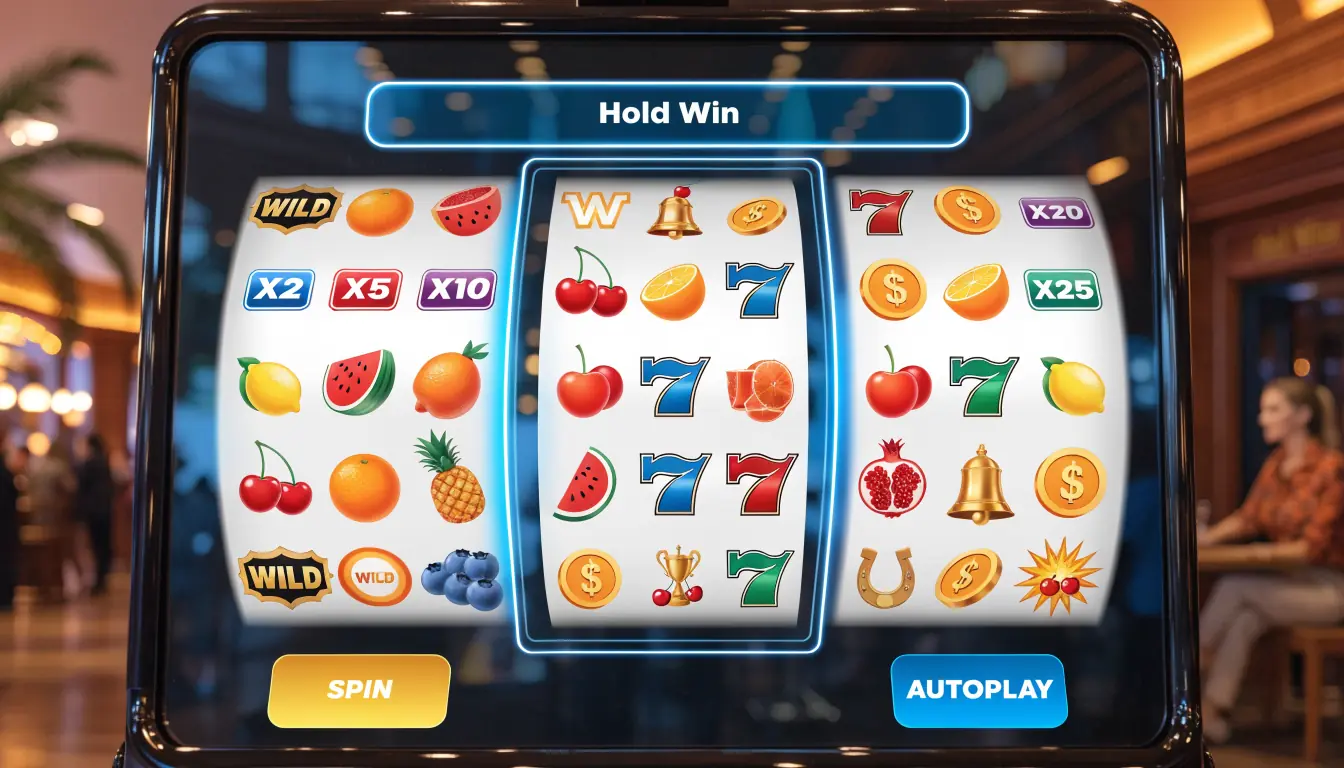
In practice, on the online versions, it tends to boil down to a handful of recognisable mechanics: wild symbols that substitute for others to complete a line, multipliers that scale up a payout when a particular combination lands, and hold-and-win style bonus rounds where certain symbols lock in place and re-spin for a shot at collecting more. None of this is unique to 3-reel games — you’ll see the same mechanics on video slots — but on a three-reel layout they tend to be simpler to trigger and simpler to understand, because there’s less going on across fewer positions.
That simplicity is honestly the appeal. You’re not deciphering a bonus wheel inside a bonus wheel. You spin, you either land the trigger or you don’t, and the payout structure is transparent enough that the RTP figure on the info screen actually tells you something meaningful about what to expect, without ten layered mechanics muddying the picture.
Where this leaves you
Nobody can tell you what conditions, limits or requirements apply to 3-reel slots across the board in Australia — wagering rules, caps, timeframes — because that information isn’t something regulators or operators publish as a fixed, universal standard. It varies by operator, by game, by promotion, and the honest answer is that there’s no single published rulebook to point you to. Whatever applies to a specific bonus or a specific game will be on that game’s or operator’s own terms — check there, not here.
What you can rely on is the stuff that doesn’t change: RTP is a long-run design figure, not a promise about your next session; volatility tells you the shape of the wins, not just the size; the RNG doesn’t remember your last spin; and legally, playing itself isn’t the problem — it’s simply a market with no domestic licence for the product, which is a very different thing from the product being illegal for you to touch. A high RTP figure, however verified, is not a guarantee of profit over a short session — that’s true regardless of which number you’re looking at, and worth keeping in your back pocket every time a game’s info screen looks generous.
Playing 3‑Reel Slots for Real Money Online
Here’s the thing nobody tells you upfront: there’s no domestic online casino in Australia. Not a legal one, anyway. The Interactive Gambling Act 2001 makes it illegal to offer online casino games — slots included — to anyone living here. That’s the law targeting operators, not you. Playing at an offshore-licensed site isn’t illegal for an individual Australian. I checked this more than once before I believed it, because it sounded like the kind of loophole that gets closed the moment you rely on it.
It hasn’t been closed. But "not illegal for you" and "safe" aren’t the same sentence, and I learned that the hard way with a withdrawal that took longer than I’d like to admit.
What real money actually changes
Nothing about the math changes once you’re betting real money instead of play credits — the RTP is baked into the game regardless. What changes is that now the percentage isn’t abstract. Say a machine takes $110,000 in total bets across its player base and pays back $100,000 in winnings. That’s a 90.9% RTP. Fine on paper. Less fine when you’re the one feeding it $20 on a Tuesday night and watching the reels not cooperate.
RTP is a long-run number. It’s calculated over enormous sample sizes, not over your session. I’ve had nights on a supposedly generous 3-reel game where I walked away with nothing, and nights on a "tighter" one where I cashed out early and quit while I was ahead. Neither proves anything about the machine. It just proves random is random.
The offshore reality
Because there’s no licensed local option, every real-money 3-reel slot you’ll find is running through an offshore operator. Some are properly regulated by bodies overseas, some are dressed up to look like they are. That distinction matters more than the size of the welcome offer. I’ve stopped judging a site by how good the deposit bonus looks — "generous" bonuses tend to hide behind terms nobody reads — and started looking at whether the operator is straightforward about how it’s licensed and audited elsewhere.
None of this is advice to go find one. It’s just the honest shape of the situation: playing 3-reel slots for real money online, from Australia, means playing offshore, means the protections you get depend entirely on which offshore outfit you picked, not on any local safety net. There isn’t one. That’s not a technicality — it’s the whole picture.

Free 3‑Reel Slots with Bonus – No Download Needed
You don’t need to install anything to try 3-reel slots with bonus rounds. Every operator I’ve bothered to check runs its games straight in the browser, same as any other webpage. No app, no update, no "compatible device" nonsense.
The free versions run on play money, so there’s nothing to lose while you figure out whether a bonus feature actually pays or just looks nice. That part’s genuinely useful before you switch to real stakes.
Here’s the bit worth knowing: online slots run a higher RTP than the machines you’d find in a physical venue. A game built with a 96% RTP returns about $96 for every $100 wagered over the long run — and that number applies whether you’re playing for fun or for real money, since it’s baked into the game itself.
Free play won’t show you that number directly. But it’s the same math running underneath either way.
How to Play 3‑Reel Slots Online Safely
Here’s the part nobody likes explaining: there’s no such thing as a licensed Australian online casino. None. The Interactive Gambling Act makes it illegal to offer slots, poker, blackjack or roulette to residents here — that’s the 2001 version of the law, though you’ll still see the 1997 Act cited in older articles saying the same thing. Different year, same message.
Playing yourself isn’t illegal. The Act goes after operators, not players. But that also means there’s no local regulator checking anything for you, no register to look up, no licence badge that means what it would somewhere else.
So the "safety" part is on you: only play if you’re 18 or older, treat every session as entertainment money you can afford to lose, and if it stops feeling like fun, Gambling Help Online is there for a reason. Not a footnote — an actual resource.
Can I play online pokies for free?
Yes, most online casinos offer demo modes for pokies, letting you play with virtual credits instead of real money. This gives you a chance to test the volatility and mechanics before wagering anything.
What law governs online gambling in Australia?
The Interactive Gambling Act 2001 (IGA) is the primary Commonwealth law governing online gambling, focusing on harm minimisation. It prohibits operators from offering online casino games to Australians, though individual players aren’t penalised for using offshore-licensed sites.
Can I play on an Australian online casino on mobile?
Yes, modern online pokies and casino platforms are built to run smoothly on mobile browsers and dedicated apps. Whether you’re playing 3-reel classics or video slots, the RNG and gameplay mechanics remain identical across desktop and mobile.
How can a player verify that an online casino holds a valid licence in Australia?
Legitimate offshore operators display their licensing credentials at the bottom of their homepage, and you can cross-check the licence number directly on the regulator’s website. Additionally, regulatory certification requires third-party RTP verification, which proves the games have been audited.
Created by the ”Casino Payments Info” editorial team.