
Best Live Casino Online Australia: What to Check First

Table of Contents
- What Makes a Live Casino Experience Truly Live in Australia?
- Free Live Casino Software Providers and Their Security Features
- Live Casino Poker Options and What to Watch Out For
- Top Live Casino Games: Volatility, RTP, and Player Preferences
- Roulette Live Casinos: Legal Landscape and Site Selection
- Live Dealers: Who They Are and How They Enhance Your Play
- Live Casino Access in the USA: Regulations and Practical Tips
- Playing Live Casino from Other Countries: Malaysia, Canada, and Beyond
- Best Live Casino Apps and How to Choose the Top One
- Live Casino in Australia: Key Requirements and Local Highlights
What Makes a Live Casino Experience Truly Live in Australia?
First time I sat down in front of a live blackjack stream, I kept waiting for something to prove it was "real" — a delay, a stutter, the dealer sneezing, anything. That’s the wrong instinct. What actually makes a live casino live isn’t the video quality. It’s whether the whole chain around that video — who’s allowed in, what currency you’re playing with, how fast your money comes back out — actually holds up once you stop watching the dealer and start watching your account balance.
A lot of sites will show you a nice stream and call it a day. That’s not the same thing.
Age and access come first, not last
Every legitimate live casino operating for Australians requires you to be 18 or older before you get anywhere near a table. Not a suggestion, not a checkbox you can lie past casually — it’s the baseline the entire rest of the experience sits on. If a site skips this or makes verification feel optional, that’s not a live casino worth your time, it’s a liability wearing a nice interface.
Worth saying plainly here too: no online casino, live or otherwise, is licensed to operate out of Australia. The Interactive Gambling Act 2001 makes that illegal for the operators themselves. It’s not illegal for you as a player to use an offshore-licensed site — the law targets the businesses, not the person sitting at home with a drink watching a roulette wheel spin. But that also means nobody’s handing out a tidy local "gold star" licence for you to check. There’s no register to look it up in. So the things that actually tell you a live casino is legitimate are more practical than legal: does it take your currency, does it pay you back, does it work on the device in your hand.


Your dollars, not someone else’s
By 2026, live casinos serving Australian players accept AUD deposits directly. This sounds like a small thing until you’ve played somewhere that doesn’t — where every bet is quietly recalculated through USD, and you can’t tell if you won or if the exchange rate just moved. Playing in your own currency means the number on the screen means what it says. No mental math at the table, no unpleasant surprise when you go to cash out and discover the site "settles" in a currency you never agreed to.
The withdrawal is the real test
Here’s the thing nobody tells you before you deposit: the live stream is the easy part. Every provider can bolt a camera onto a card shoe. The part that separates a genuinely solid live casino from one that’s just good at marketing is what happens when you try to take money out.
PayID changed this more than anything else I’ve used. According to one industry review of top-rated Australian sites, PayID withdrawals average somewhere between 2 and 4 hours — and on some platforms, verified players have had money land in under 30 minutes. Compare that to the old wire-transfer days, where "processing" meant "check back in a few business days and hope." The same review put the average processing time across top-rated sites at under 24 hours, with some operators — Wild Tokyo among them — clearing verified withdrawals in under an hour.
Withdrawal times can vary widely; the review numbers are not a guaranteed rule and depend on the casino’s verification setup and how quickly you complete your ID checks.
I want to be careful here: that’s one review’s numbers, not a rule stamped into every operator’s terms. Processing speed depends on the casino’s own verification setup and, frankly, on how quickly you did your ID checks in the first place. Same review noted PayID transactions can clear in minutes even on weekends and public holidays, which — if you’ve ever tried to get a bank transfer processed on a Sunday — is the actual upgrade here. Not the graphics. The money.
If a site can’t tell you clearly how withdrawals work, or the answer is buried in a FAQ that reads like it was written to be skipped, that’s your answer already.
PayID over a card, basically every time
A few practical notes from actually using this stuff:
- PayID is the standard now for a reason — it’s built for exactly this, instant transfers tied to something you already have (phone number, email), not a card number you’re typing into a foreign payment gateway.
- Bank transfers still exist but they’re slower and give the bank more visibility into where your money’s going — which matters, because Australian banks can and do block transactions to gambling-related merchants.
- Crypto is the other route around that particular wall, though it comes with its own volatility and isn’t for everyone.
None of this is about finding a "trick." It’s about not losing three days of your life waiting for a withdrawal that should take an afternoon.
Mobile isn’t an add-on anymore
This one surprised me the first time I actually looked at how I play. Mobile sessions now make up over 70% of all online gambling activity in Australia, according to one industry review — and once I noticed that in my own habits, it explained a lot. Nobody’s sitting at a desktop for a live dealer session anymore. You’re on the couch, on the train, half-watching something else. A live casino that hasn’t optimised properly for a phone screen — buttons too small, stream lagging on mobile data, chat overlapping the cards — isn’t really built for how Australians actually play in 2026. It’s built for a desktop demo that looked great in a pitch meeting.
What "truly live" actually means
Strip away the marketing and it comes down to four things working together: you’re old enough and verified to be there, your deposit and payout happen in AUD without a currency tax on your winnings, PayID gets your money out in hours instead of days, and the whole thing runs properly on the phone in your pocket. Miss any one of those and you’ve got a live stream with problems attached — not a live casino.
Free Live Casino Software Providers and Their Security Features
Before I ever put money on a live table, I spent a stupid amount of time trying to figure out who actually builds the thing behind the dealer’s camera feed. Turns out it’s not the casino itself. It’s a software provider licensing the tech to dozens of sites at once, which is why you’ll see the same studio, same dealer uniforms, same table layout on three "different" casinos. Once you notice this, the whole industry looks a lot less mysterious.
“Free” means you never pay to access the tables – there are no software downloads, subscriptions, or unlocking fees.
"Free" in this context doesn’t mean the casino pays nothing — it means you, the player, never pay to access the tables. No software downloads, no subscription, no unlocking fees. You just open the site or app and the stream loads. If a platform ever asks you to pay upfront for "premium" live tables, that’s not how this works anywhere legitimate, and it’s a sign to close the tab.
What the software actually has to do
A live casino platform is running a real-time video stream, a betting engine, and a payment layer all at once, usually from a studio you’ll never see and can’t visit. That’s a lot of moving parts, and each one is a place where something can go wrong — a delayed stream, a bet that doesn’t register, a withdrawal that gets stuck. The providers that have stuck around for years are the ones where those parts mostly don’t break.


The baseline security measure worth checking for, regardless of which provider is running the tables, is 256-bit SSL encryption on the connection between your device and the casino’s servers. This is what the best Australian platforms use to protect your card or PayID details and your session data while you’re playing. It’s not something you’ll ever "feel" as a player — there’s no badge that pops up saying "you are now safe" — but you can check for it in the browser’s address bar, and if it’s missing, I wouldn’t type in a single digit of my banking details.
The providers you’ll actually run into
Most of the names powering live tables across Australian-facing sites will look familiar if you’ve played pokies too, because a handful of studios build both slot content and live dealer software.
- Pragmatic Play — known primarily for slot titles, but also runs live dealer tables through its own studio setup.
- Microgaming — one of the older names in the industry, licenses live casino content to a wide network of operators.
- NetEnt — another long-running provider, present on plenty of sites that also carry its slot catalogue.
- Play’n GO — mostly associated with pokies, occasionally shows up bundled into live casino lobbies.
- BGaming — smaller footprint, but shows up on some offshore-licensed platforms.
None of these require you to download or install anything to play. The stream and the betting interface run in the browser or the app, same as a video call would. If a site tells you that you need special software to access its "exclusive" live tables, that’s a red flag, not a selling point — legitimate providers built their whole business model around not making you do that.
Where security actually breaks down
Encryption on the connection is one layer. The other layer — the one people forget about — is what happens to your money after you’ve placed a bet. This is where Australian players run into a problem that has nothing to do with the software provider at all: local banks blocking transactions to gambling sites. It happens, and it’s not the casino’s fault or yours — it’s the bank flagging the transaction on its end.
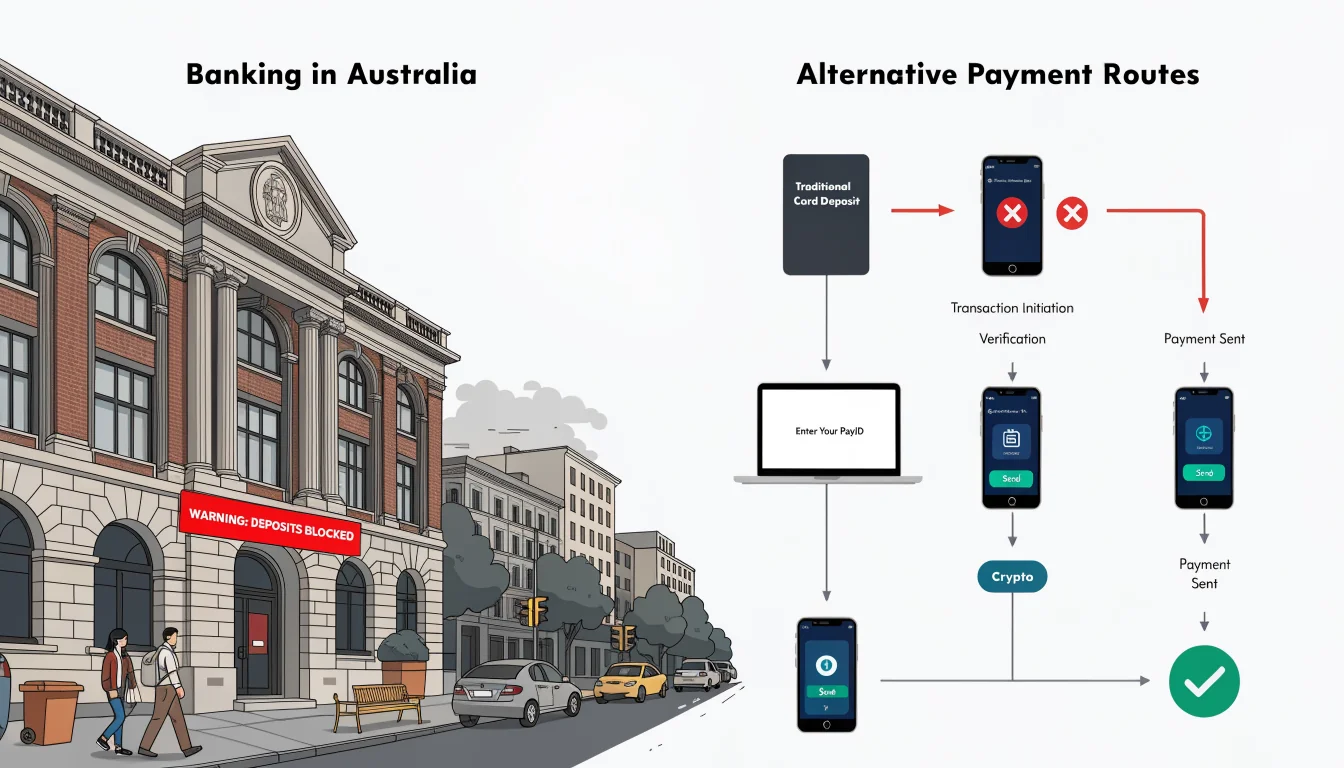
PayID and crypto deposits are the two ways around this that actually work, because they route the payment differently than a straight card transaction. I’ve had a bank card get declined for a deposit and then had the same amount go through instantly on PayID five minutes later, no explanation needed. If a site doesn’t offer either option, that’s worth factoring in before you commit to it, because it’s not really about which software provider is running the tables — it’s about whether your money can get in and out at all.
RTP isn’t really a live casino thing, but it still matters
One thing that trips people up: RTP (return to player) is a term that gets thrown around for live tables, but it’s mostly a slots metric. Live blackjack, roulette, baccarat — these have fixed mathematical odds based on the rules of the game itself, not a programmed RTP percentage the way a pokie does. Where RTP genuinely matters is on the real money pokies sitting in the same lobby as the live tables, where the best Australian platforms typically run somewhere in the 95–97% range. Worth knowing, but it belongs to a different part of the site than the one this section is about.


What I actually check now
Before I bother creating an account anywhere, I look for the padlock icon confirming the encrypted connection, I check whether PayID is listed as a deposit and withdrawal method, and I see which software provider’s logo shows up in the live lobby — not because one is definitively "better," but because a name I recognize from other sites means there’s a track record, however imperfect, rather than nothing at all.
Live Casino Poker Options and What to Watch Out For
I spent a solid month bouncing between live poker rooms before I figured out what actually separates a decent room from one that’s quietly designed to keep your money. The tables themselves all look similar enough — a dealer, a shoe, a chat box where someone’s always typing "gl" — but the differences that matter are buried in the terms, not the felt.
Withdrawal test details
Poker rooms live and die on how fast they let you leave with your own winnings. If a site’s terms mention five days or more for a standard withdrawal, that’s a red flag. It’s wise to test with a small deposit before committing larger sums.
First thing I check now, before I even sit down: the wagering requirements on whatever sign-up offer got me there. If a bonus attached to the poker room demands 60x or higher before you can touch the winnings, walk away. That’s not a generous offer, it’s a number designed to look generous while making sure the house wins the war of attrition. I didn’t know this the first time and cleared maybe a third of a bonus before I ran out of patience and money in roughly equal measure.
The withdrawal test
Poker rooms live and die on how fast they let you leave with your own winnings. If a site’s terms mention anything like five days or more for a standard withdrawal, that’s your answer before you’ve played a single hand. A room that’s confident in its numbers doesn’t need to sit on your cashout that long. I’ve had withdrawal pages that just… didn’t load properly, which taught me to test this with a small deposit before anything serious.
Currency games
This one’s specific to Australians and it’s sneaky. Some live poker platforms are built around USD or EUR tables, and if the site doesn’t support AUD directly, you’re eating conversion fees on every deposit and every withdrawal. It’s a small percentage each time, but it adds up over a session, and it’s the kind of cost that never shows up in the marketing. Check whether the cashier actually lists your currency before you fund anything — not whether the homepage mentions "Australia," which plenty of sites do without actually supporting AUD.
If a site doesn’t support AUD directly, you’ll incur conversion fees on every deposit and withdrawal, which can quickly erode your bankroll.
Table selection that isn’t really a selection
The other trap is thin game libraries dressed up as variety. A site advertising "poker" might run two or three table types on rotation, same stakes, same format, nothing else. Pair that with a wider platform running under 500 pokies total and you’re looking at an operator that’s stretched thin rather than genuinely stocked. Selection matters because it tells you something about the operator’s actual investment in the product, not just its marketing budget.
Fine print on bonuses
Poker-specific promos are where I’ve seen the worst fine print. "Bonus" gets thrown around loosely — sometimes it only applies to cash games, sometimes only to a specific table, sometimes the terms exclude poker entirely while the banner implies otherwise. Read the actual bonus terms page, not the promo tile. If the conditions take three read-throughs to understand what qualifies, that’s the point — confusion is the business model.
What a decent room looks like
- Withdrawal terms stated clearly, not buried three pages into a T&Cs document
- AUD listed as a supported currency in the cashier, not just mentioned on the landing page
- Wagering requirements shown before you accept any bonus, not after
- More than a token handful of poker variants, alongside a broader library that suggests the operator isn’t running on a shoestring
None of this is exciting to check. It’s the opposite of exciting, which is exactly why most people skip it and find out the hard way. I’d rather spend ten minutes reading terms than spend a week emailing support about a withdrawal that’s gone quiet.
Top Live Casino Games: Volatility, RTP, and Player Preferences
I used to think "volatility" was just a word slapped on a game info page to sound technical. Then I sat through a session on a high-volatility title, watched my balance flatline for what felt like forever, then spiked once — hard — and I finally got it. Volatility is just a fancy way of saying "how long is the drought before the flood."
That distinction matters more than most people realise when they’re picking what to play.
High volatility vs low volatility, in plain terms
High-volatility pokies pay out rarely, but when they do, it’s a proper win. Lightning Link is the classic example here — you can feed it for a stretch with barely a nibble back, and then it delivers one of those wins that makes you sit up straight. If you’ve got the patience and the bankroll to ride out the quiet stretches, that’s the appeal.

Low-volatility pokies work the other way. Smaller wins, but they come more often, so the balance doesn’t do the same rollercoaster thing. Less drama, less risk of watching your deposit vanish in ten spins. It’s a legitimate style of play — not a "beginner" version of the real thing, just a different rhythm.
Neither is objectively better. It’s a mood thing, honestly. Some nights I want the slow grind. Other nights I want the shot at something big, even knowing the odds are against me.
Where RTP fits into the picture
RTP gets thrown around like it’s a promise. It isn’t. It’s a long-run average across a huge number of spins — not a guarantee for your session tonight. Still, it’s worth knowing before you commit real money.
Book of Dead sits at 96.21% RTP, which puts it comfortably in the range most Australian players consider solid for a real-money pokie. It’s also medium-to-high volatility, so you get some of that "quiet then boom" pattern without the extreme swings of something like Lightning Link.
Sweet Bonanza is one of those titles almost everyone’s tried at least once — the cluster-pay format and the multipliers make it feel different from a standard reel game. I couldn’t find a solid, verifiable RTP figure for it that I’d stand behind, so I’m not going to make one up. If a site quotes you an exact number for it, ask where that number comes from before you trust it.
RTP
RTP (Return to Player) is the long‑run average percentage of wagered money that a game returns to players, calculated over a huge number of spins or hands.
Why this actually matters for how you play
Most regular players in Australia aren’t marathon sessions — figures I’ve seen put average weekly time on pokies at around 2.3 hours, which is a handful of shorter sittings rather than one long grind. If that’s roughly your pattern too, volatility choice changes the whole feel of those sessions.
A short session on a high-volatility game can easily end with nothing to show for it — that’s just the maths, not bad luck. A short session on something lower-volatility is more likely to feel "even," win or lose.
None of this is about finding the "best" game. It’s about matching the game to how much time and money you’re actually bringing to the table, and being honest with yourself about which one that is before you load up the balance.
Roulette Live Casinos: Legal Landscape and Site Selection
Here’s the part nobody explains properly, and I got it wrong myself for a while: no Australian company can legally offer you online roulette. The Interactive Gambling Act 2001 bans local operators from providing casino services to Australian residents. Full stop. That’s why every live roulette table you’ll actually find is running through an offshore-licensed site — Curaçao, mostly. That’s not a loophole someone’s exploiting. That’s just how the market works here.
What the law doesn’t do is criminalise you for playing. Sitting down at a live roulette table on an offshore platform isn’t illegal for an individual player. The Act targets the businesses, not the punters. Worth knowing, because plenty of "warning" content online implies otherwise to scare you off, or worse, to push you toward some "fully compliant" site that doesn’t actually exist — because there’s no domestic licence to comply with in the first place.
So if legality of the site itself under Australian law isn’t the filter, what is? Practical stuff. Whether your money moves in and out without drama.
Roulette site checklist
- Payment method: ensure PayID or an Australian‑friendly option is available.
- Currency: play with AUD balance to avoid conversion fees.
- Bonus terms: verify that roulette bets count towards wagering requirements.
- Table variety: check for multiple roulette variants and reasonable bet limits.
What actually separates a decent roulette site from a bad one
- Payment method. If there’s no PayID or other Australian-friendly option, walk away. I learned this after wiring money through an intermediary e-wallet and losing three days to a “pending” screen. Sites without PayID aren’t necessarily scams, but they’re telling you upfront that you’re not really their priority market.
- Currency. AUD tables, AUD balance, no conversion nonsense. If your bankroll is quietly bleeding on every deposit because it’s being converted from USD, you’re paying a tax nobody mentioned.
- Bonus terms. Roulette specifically gets buried in wagering fine print more than most games — some bonuses simply don’t count roulette bets toward clearing the requirement, or count them at a fraction of the rate. Read that before you deposit, not after you’ve already played through half your balance wondering why the number isn’t moving.
- Table variety. European, American, live-dealer versions with different bet limits. If a site only has one lonely roulette table stuck between the blackjack rooms, that tells you where their priorities are.
On deposit sizes
I’m not going to tell you what to deposit — that’s yours to decide, and it should depend on what you can actually afford to lose, not on what looks "normal." One industry review put the average monthly spend for active Australian online casino players at $127, but that’s one snapshot from one source, not a target or a benchmark to hit. Use it as context, not as permission.
If you take one thing from this section: check the payment method and the currency before you check the game selection. A beautiful roulette table means nothing if getting your winnings out takes a week and a currency conversion fee.
Live Dealers: Who They Are and How They Enhance Your Play
First time I sat at a live blackjack table, I kept waiting for the dealer to break character or slip up somehow — some proof this wasn’t a real person. Never happened. She dealt cards, chatted with players in the room, called out totals, and ran the shoe exactly like a floor dealer would. That’s the whole point of a live table: an actual human, on camera, running the game in real time, not a random number generator dressed up with a nice background.


The dealers themselves are trained staff working out of studios, usually shift-based, running the same routines a land casino pit would use — shuffling, dealing, calling bets, settling disputes when the chat gets rowdy. What they add isn’t speed. It’s the opposite, actually. A live table moves slower than an automated one, and that’s the appeal. You see the shuffle. You see the wheel spin. You see the tiger and dragon cards flip in real dragon tiger, which is about as simple a game as live casino gets — one card each, higher card wins, no strategy to learn, just watching someone else’s hands do the work.
Where dealers genuinely change the experience is trust. Watching a person shuffle a physical deck or spin a physical wheel hits different than trusting a seed number you can’t see. Doesn’t make the game fairer on paper — RNG tables are audited too — but it removes that nagging "what if the software’s rigged" thought that creeps in during a losing streak.

What happens after the table, though
None of this matters if you can’t get your money back out. This is where I got burned early on — picked a site with a great dealer roster and painfully slow withdrawals. Lesson learned: check the payout side before you check the table selection.
PayID changed that equation for me. According to one operator’s own published terms, verified players saw withdrawals processed in under an hour. Other reviews I’ve read describe similar speed at several other sites — sometimes under an hour, sometimes a bit longer depending on how busy their cashier team is. What’s consistent across the accounts I’ve seen is that PayID keeps moving on weekends and public holidays, when card withdrawals and bank transfers usually stall for days. That’s not nothing — I’ve sat waiting on a Friday withdrawal that didn’t clear until the following Wednesday at a site that only offered bank transfer.
None of this replaces doing your own check on a specific site’s terms before you deposit. Processing times get quoted differently by different sources, and the number that matters is whatever’s written in that operator’s own cashier page — not whatever number a review site (including this one) throws around.
Quick checklist before you sit at a live table for real money:
- Confirm PayID is listed as a withdrawal method, not just a deposit one.
- Check whether weekend withdrawals are mentioned specifically.
- Watch a few hands before betting — dealer pace tells you a lot about table quality.
Live Casino Access in the USA: Regulations and Practical Tips
A mate of mine moved to the US for work and messaged me asking if he could still play at the same live tables he used back home. Short answer: it’s complicated, and it’s a different mess to Australia’s.
The US doesn’t have one federal answer. Gambling law there is state-by-state, so what’s fine in one state can be a grey zone in the next. A handful of states have legal, regulated online casino markets. Most don’t. That means the same site can be perfectly legit for a player in one state and off-limits for someone a few hundred kilometres away, and the platform itself is the one that has to check.
None of this is Australia’s legal framework, and I’m not going to pretend it is. Under Australian law, individual players aren’t the ones breaking rules by using offshore-licensed sites — the restriction sits on operators. The US system is built differently, with state regulators licensing specific operators for specific borders. If you’re an Australian reading this because you’re heading to the US, or you’ve got family there asking, treat it as its own separate question, not a variant of what applies at home.
A few practical things that actually matter if this comes up:
- Location gets checked, not just claimed. Regulated US platforms use geolocation, not just an address field on a signup form. Being in the “right” state on paper doesn’t help if your phone’s GPS says otherwise.
- Payment methods follow the same state lines. A card or bank method that works in a licensed state may simply fail elsewhere — that’s the platform blocking it, not a glitch.
- Currency and account details don’t travel well. An AUD-based account set up for Australian play isn’t something you carry over into a US-regulated one; they’re separate systems with separate rules.
If in doubt, the honest move is to check the specific state’s own gambling regulator page before signing up anywhere — not a comparison site, the regulator itself.
Playing Live Casino from Other Countries: Malaysia, Canada, and Beyond
I’ve got mates scattered across Kuala Lumpur, Toronto, and a cousin in Mumbai, and every one of them has asked me at some point whether they can just log into the same live casino I use. Short answer: sometimes, but the details matter more than the "yes."
Live casino access depends entirely on where the operator is licensed to accept players, not where the servers or dealers happen to be. An offshore-licensed site that welcomes Australians might block Malaysian IP addresses outright, or let Canadian players in but strip out certain tables. I learned this the annoying way, trying to get a mate in Ontario onto a platform I use here — he could see the lobby, couldn’t touch a single blackjack table.
PayID is an Australia‑only system; players outside Australia will hit a wall if the site relies on PayID for deposits or withdrawals.
Currency is the other snag. Everything I use runs on AUD deposits, which is exactly the point — no conversion fees eating into a win before it even hits your balance. Someone in Malaysia or India logging into an AUD-only site is stuck converting their own currency twice: once going in, once if anything ever comes out. That’s not a small "inconvenience." That’s money gone before you’ve placed a single bet.
Payment rails don’t travel well either. PayID is an Australian system — it doesn’t exist for players in Canada or Malaysia, so anyone outside Australia trying to use a site built around PayID withdrawals is going to hit a wall or get shuffled onto a slower, clunkier option instead.
None of this is about legality on the Australian side — the Interactive Gambling Act 2001 targets operators, not players, and that’s true regardless of which country’s dealers you happen to be watching. It’s about whether the platform is actually built for your currency, your payment methods, and your region. A live casino that works brilliantly for me in Sydney can be a half-broken experience for someone dialing in from Kuala Lumpur or Toronto, and that’s got nothing to do with luck.
Best Live Casino Apps and How to Choose the Top One
With so many live casino sites competing for your attention in 2026, it helps to see how each one stacks up on bonuses, payout speed, and deposit requirements before you sign up.
Bonus: up to A$750 + 50 jackpot spins, 35x wagering · Payout speed: crypto ~90 minutes, fiat 1-5 days · Min. deposit: A$30 Kingmaker pairs a solid welcome bonus with jackpot spins, backed by fast crypto payouts and a low entry deposit that makes it easy to get started.
License: Curacao eGaming OGL/2023/174/0082 (Dama N.V.) · Bonus: up to A$10,000 + 500 free spins across 4 deposits · Min. deposit: A$15 LevelUp Casino runs on a Curacao license and stands out with a large multi-deposit bonus package plus a low minimum deposit, making it accessible for new players.
License: Curacao · Bonus: 100% up to A$500 + 200 free spins, 10x wagering · Payout speed: crypto 30-60 minutes, fiat 1-5 days · Min. deposit: A$10 Wild Tokyo offers a Curacao-licensed experience with a generous welcome bonus at a manageable wagering requirement, plus quick crypto withdrawals and a very low minimum deposit.
Bonus: 240% up to A$4,100 + 300 free spins WinShark brings one of the more substantial percentage-based bonuses on this list, combining a high match rate with a large free spins package.
Bonus: up to A$7,500 + 550 free spins across 10 deposits, 50x wagering · Payout speed: crypto under 1 hour, PayID 1-3 business days · Min. deposit: A$20 (A$30 to qualify for the bonus) Ricky Casino spreads a sizeable bonus across multiple deposits and offers rapid crypto payouts alongside PayID processing, though the bonus does require a slightly higher qualifying deposit.
License: Curacao Gaming Control Board OGL/2023/176/0095 (Hollycorn N.V.) · Bonus: up to A$11,000 + 300 free spins (code NEO100) Neospin is licensed under the Curacao Gaming Control Board and offers one of the largest bonus values here, unlocked with a specific promo code.
License: Tobique Gaming Commission · Bonus: up to A$8,000 + 400 free spins across 4 deposits · Payout speed: crypto ~10-15 minutes, fiat 1-5 days · Min. deposit: A$30 SkyCrown holds a Tobique Gaming Commission license and delivers a strong multi-deposit bonus with notably fast crypto withdrawal times.
License: Curacao eGaming (Dama N.V.) · Bonus: up to A$10,000 + 180 free spins, 40x wagering JeetCity Casino is Curacao eGaming licensed and offers a large bonus with a defined wagering requirement, giving you clear terms to work with.
License: Curacao Gaming Authority (Jumpman Gaming Ltd) · Bonus: up to A$6,600 + up to 250 free spins across 4 deposits DragonSlots Casino operates under a Curacao Gaming Authority license and spreads a generous bonus across several deposits, adding a solid free spins component.
License: Curacao eGaming (Roby Games Ltd) · Bonus: 100% up to A$750 + 200 free spins Roby Casino is Curacao eGaming licensed and keeps things straightforward with a matched welcome bonus plus a free spins bundle.
I used to think the app was just a smaller version of the website. Wrong. Some apps run on a proper native build, some are just the mobile site wrapped in a shell and slapped on a home screen icon. You can usually tell within a minute — native apps load the live dealer feed faster and don’t stutter when you rotate the screen mid-hand.
Downloading one isn’t complicated. Android users typically grab an APK straight from the operator’s site, since these platforms won’t show up in the Play Store — that’s just how offshore casino apps work everywhere, not an Australia-specific quirk. iOS is usually a browser-based "app" you add to your home screen rather than a native install. Neither process should ask for anything beyond confirming you’re 18 and setting up your account.
What actually separates a good app from a bad one, in my experience:
- Stream stability — the video feed shouldn’t drop every time you switch from Wi-Fi to mobile data.
- Full game parity — if the desktop site has a table, the app should have it too. Some apps quietly strip out half the live poker rooms to save bandwidth.
- PayID built into the app — not redirected to a mobile browser to finish the deposit or withdrawal. That redirect step is where half the complaints about slow payouts start.
- Session memory — logging back in shouldn’t force you to re-verify from scratch every single time.
Behind all of this sits the same software providers running the tables you’d find on desktop — the app is just the pipe, not the source. If the underlying provider is solid, the app experience usually follows. If it’s a shaky white-label build, no amount of app polish fixes a laggy dealer feed.
One thing I stopped doing: judging an app by its icon or store rating. Rating means nothing when the app isn’t even in an official store. Test the stream, test a small withdrawal, then decide.
Live Casino in Australia: Key Requirements and Local Highlights
Strip away everything else in this guide and three things actually decide whether a live casino is worth your time here.
You need to be 18 or older — no site worth using will let you past the age gate without checking. AUD support isn’t optional either. If a table quotes you in USD and converts on the way out, that’s a sign to close the tab, not a detail to "get used to." And PayID should be sitting right there next to the usual deposit options, because that’s the payment rail that actually moves at Australian speed, not overseas card processing that takes days.
On licensing: there’s no local badge to look for. No Australian regulator issues licences for online casino games, live dealer tables included — that’s just how the law here works. What you’re checking instead is whether the operator is upfront about who licenses them offshore and whether their terms are readable without a law degree.
What makes the good Australian-facing tables stand out isn’t a special local feature — it’s the boring stuff done right. AUD from the first deposit, PayID on the way out, dealers running games at hours that don’t force you to play at 4am. That’s the whole highlight reel.
What law governs online gambling in Australia?
The Interactive Gambling Act 2001 prohibits Australian companies from offering online casino services to residents, but it’s not illegal for you to play at offshore-licensed sites — the law targets the operators, not the players.
What is the minimum legal gambling age in Australia?
You must be 18 or older to play at any online casino serving Australian players. Legitimate sites enforce this through mandatory verification before you can access live tables.
How does PayID withdrawal work at Australian online casinos?
PayID ties instant transfers to your phone number or email rather than a card number, letting you bypass bank blocks on gambling merchants. At top-rated sites, withdrawals average 2 to 4 hours and can land in under 30 minutes for verified players.